Down to the deepest working face.
A supported loading bay launches the jewel into a deep, rotating fall. We follow it across the lowest working threshold and fully inside to Hellminer’s heel, rise into his backswing, follow the impact, then arc toward his eyes before retreating through the new gap.
Candidate artwork for your review. No Runway video generated; 0 Runway credits used. Existing game, storyboard and music remain unchanged.
16 selected waypoints: 7 revised/new, 9 retained. The deep fall includes an explicit rock-covered depth/time ellipsis. The boot-to-pick reveal and flank-to-face path now have destination frames—not 16 film holds or a paid render queue.
What to check first
- Track bend, loading buffer/brake, intact cart sides and supported posts are now explicit.
- No nearby upper work room or repeated loading cart in the deep fall.
- Jewel changes orientation; chips disperse; a planned occlusion compresses descent time.
- Threshold crossing → completed inward roll → heel/calf/backpack → drawn-back overhead pick.
- Side waypoint puts old quarry mouth and new opening on opposite sides before the face reveal.
- Approved strike, face, retreat and Hell dive retained; actual orbit and contacts still need testing.
Source length ≠ film length
Prior UI inspection found Kling 3.0 Standard controls accepting 3–15 seconds, in whole seconds, with first and last images. The 3-second labels below are minimum-length test candidates—not final scene lengths.
The transitions have a 9.00-second draft edit budget, not verified lyric timing. It is a fast motion sketch, not a slideshow playback. Two transitions are explicit edits: depth/time ellipsis and forward turn. The flank orbit is a candidate with a debris-cut fallback. Source lengths remain separate: do not automatically buy a 3-second clip for each pair or assume trimming preserves useful action.
Download reference audioA deep descent and a boot-to-pick reveal
The jewel now descends many galleries to the lowest active face. A rock-covered edit deliberately compresses depth/time. We see it cross the doorway, roll fully inside, and lead the camera up the boot into a real backswing. The new flank waypoint explains the intended route around to his face; if that generated orbit fails, a deliberate debris-covered cut is the fallback.
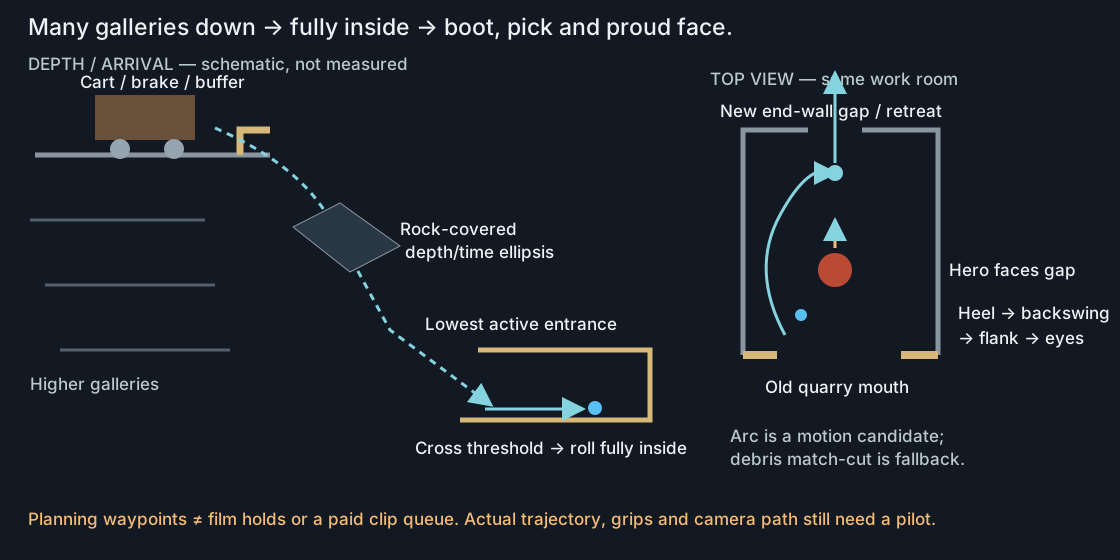
Planning schematic, not film artwork or a reconstructed 3D set. Endpoint stills cannot guarantee correct intermediate motion.
Selected frames in story order
Click any image to inspect the original PNG. Labels are narrative order, not song timestamps.
Camera/action contracts
Each pair gives the intended destination and the physical movement needed to reach it. The deep-fall time ellipsis and forward turn are marked as edits. The new flank-to-face orbit is an unverified motion candidate with an explicit debris-cut fallback.
Motion planning limits
Prior UI inspection found Kling 3.0 Standard Frames controls supporting first and last images, with 3–15-second source lengths in whole seconds. These are source lengths, not the final edit lengths.
The jewel and flank waypoints are possible clip boundaries, not assumed precisely timed middle pins. Recheck the selected model’s current controls and price before any paid pilot. No automatic per-pair render queue.